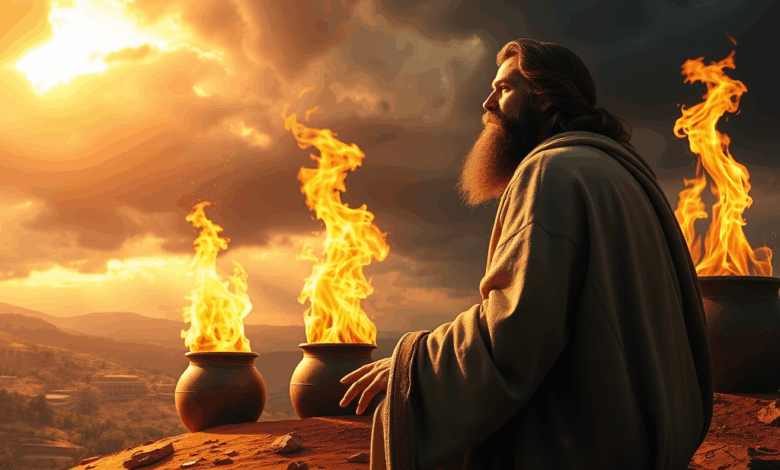
During a weekday prayer meeting last month September, the Lord showed me four pots put on fire. Then, the Lord untied Elijah’s miraculous fire from heaven. This was a powerful testament to divine intervention. I understood the essence of the spirit. It showed me The Revival: Elijah’s Miracle of Fire from Heaven. This revival is about to take place in the hearts of people. It will also occur in his church. The extraordinary moment in Elijah’s time is steeped in dramatic tension. It unfolds with spiritual significance against the backdrop of ancient Israel.
This was a time when a nation teetered on the brink of apostasy. As Elijah confronts the prophets of Baal on Mount Carmel, the stakes reach a fever pitch. The nation’s fate hangs in the balance. He boldly calls upon the Almighty. It was a challenge to test the boundaries of belief and the potency of prayer. This revival, marked by fire and fervor, ignites a flame of faith that resonates through generations.
Join me. Let’s explore this captivating narrative. We will untie its implications for both ancient and modern believers. We will uncover the enduring message of hope and revival. This message continues to inspire our spiritual journeys today.
Historical Context of the Miracle
The story of Elijah’s miraculous fire from heaven unfolds during a turbulent time in ancient Israel. The nation grappled with its identity and spiritual direction. This period is known as the era of the divided kingdom. During this time, Israel split into two factions: the northern kingdom of Israel and the southern kingdom of Judah. The northern kingdom was ruled by King Ahab. It had turned away from traditional worship of Yahweh. It embraced the pagan cult of Baal. Ahab’s marriage to Jezebel, who was a fervent devotee of Baal, intensified this drift towards idolatry. This alliance created a climate ripe for apostasy. Moral decay ensued.
During this time, the people of Israel found themselves at a crossroads. They were torn between the worship of Yahweh and the seductive allure of Baal. Baal was a Canaanite deity associated with fertility and rain. He promised agricultural prosperity and economic stability. His promises appealed to the pragmatic concerns of the populace. The spiritual leaders, prophets of Baal, were deeply entrenched in the socio-political fabric of Israel. They wielded considerable influence over the king and the people. In a time of spiritual ambivalence, Elijah emerged as a prophet of Yahweh. Despite the political tension, he became a beacon of unwavering faith and divine conviction.
The Significance and Symbol of Fire in Biblical Texts
In the Bible, fire consistently symbolizes God’s presence, power, purity, and judgment. From Moses’ burning bush to Pentecost’s tongues of fire, it represents divine communication and intervention.
In Elijah’s story, the fire from heaven is more than a miracle. It’s a spiritual sign affirming God’s supremacy over false gods. This validates Elijah’s prophetic mission. It calls the people back to true worship.
The fire’s ability to consume the altar, sacrifice, stones, and water demonstrates its transformative power. It led to national repentance and sparked a revival. This moment became a turning point in Israel’s spiritual history, confronting idolatry and restoring holiness.
Ultimately, the fire reminds us that God answers sincere prayer, responds in impossible situations, and calls His people to repentance. This enduring symbol continues to inspire faith, obedience, and a renewed commitment to God today.
The Revelation and Lessons Learned From Elijah’s Miracle
As Elijah prepared the altar on Mount Carmel, he gave a strange command. He said, “Fill four jars with water and pour it on the offering and on the wood” (1 Kings 18:33). But he didn’t stop there. He instructed them to do it a second time. Then he asked for it a third time. This continued until twelve jars of water had been poured out (1 Kings 18:34-35). At first glance, this might seem like just a dramatic act. It seems to show that God’s fire was real. However, it holds deeper meaning.
During a time of prayer, the Lord gave a vision. In it, the four jars and three rounds of pouring stood out. Together, they make seven — a number that in Scripture often symbolizes rest, perfection, and completeness (Genesis 2:2-3, Revelation 1:4). It felt like God was saying, “Even when the situation looks soaked, lifeless, and hopeless, I can still bring fire. I can still bring deliverance. I can still show Myself strong.” In other words, God was preparing His people to witness His perfect and finished work in an impossible situation. But there’s more. The total of twelve jars also points to the twelve tribes of Israel — a picture of the whole nation. Elijah had used twelve stones to rebuild the altar (1 Kings 18:31), representing God’s covenant people.
Modern-Day Applications of Elijah’s Faith
The miracle on Mount Carmel isn’t just a dramatic Bible event. It’s a clear example of bold faith. This faith still speaks to us today. The nation was divided, confused, and chasing false gods. Elijah stood alone. He was fully confident in the power of the living God. His actions remind us that true faith often requires standing firm, even when you’re outnumbered or misunderstood.
One key lesson from Elijah’s faith is obedience even when it doesn’t make sense. He poured twelve jars of water on a sacrifice meant to be burned — that defies logic. But Elijah wasn’t trying to make sense; he was obeying God. Today, God may ask us to trust Him in ways that seem impossible. We may need to forgive someone who hurt us. He might ask us to give when we feel we have little. We might also need to believe for healing when all hope seems lost. Like Elijah, we must obey first, and let God show His power.
Elijah also shows us the power of prayer rooted in relationship, not performance. The prophets of Baal shouted and danced all day. They received no result. In contrast, Elijah simply prayed a short, sincere prayer. Then, fire fell from heaven (1 Kings 18:36–38). This reminds us that effective prayer isn’t about how loud or long we pray. It’s about knowing who we’re praying to.
Finally, Elijah’s faith challenges us to live in a way that points others back to God. When the fire came down, the people cried out, “The Lord—He is God!” (1 Kings 18:39). Our lives, our choices, and our obedience can still lead others to this same declaration.
In a world full of noise, confusion, and spiritual compromise, Elijah’s faith shows us how to live with clarity. It teaches us to have courage and conviction. We can fully trust that God still answers by fire.
Conclusion: A Call to the Altar of Revival
Elijah’s miracle of fire on Mount Carmel is more than a historical event—it’s a prophetic blueprint for revival today. Just as fire brought Israel back to God, we now stand at a spiritual crossroads, and God is once again stirring His people for a fresh outpouring.
The twelve jars of water represent all of God’s people, and the three rounds of four jars (totaling seven) symbolize divine completeness and restoration. Even in spiritually dry or hopeless conditions, when we walk in obedience and faith, God responds with fire—a fire that purifies, empowers, and awakens.
This is a call to rebuild the altar in our hearts, step away from confusion and compromise, and return to bold prayer and holy living. The God who answered by fire then still answers today. True revival isn’t driven by hype or performance—but by holiness, obedience, and prayer. Now is the time. The fire is coming. The Lord—He is God!